How the Shrink Flotation Method Works in Modern Mining Industries
Pallabi Das
3/25/20264 min read
Mining has always been important for the growth of industry because it gives us the raw materials we need to make, build, and use technology. Modern mining companies are always looking for new ways to get minerals out of the ground because more and more people want them. The Shrink Flotation Method is one of these. It's a quick way to get minerals back. This method uses both old and new flotation methods to get the most out of the material and cut down on waste.
How the Shrink Flotation Method Works
With the Shrink Flotation Method, you can mine minerals and process them at the same time. It has two main parts:
Miners use a traditional method called "shrinkage stopping" to get ore from veins that go down steeply.
Froth flotation is a new way to process minerals that separates useful minerals from waste rock.
By using a mix of these methods, mining companies can get more ore out of the ground and process it more quickly. This will help the economy grow and make it more likely that things will be found.
Instructions in Steps
Stopping the shrinkage so the ore can come out
The first step is to stop the shrinkage, which happens when ore is taken from an ore body that is very steep or vertical. Workers drill and blast parts of the ore, which breaks up the rock and lets it pile up in the stope, which is the area that has already been mined. You can do two things with this broken rock:
It keeps the walls of the stope from falling down.
It gives miners a place to drill and do their jobs.
Only some of the broken ore is taken away during extraction. The rest stays in the stope for a while.
Getting ore and making sure it stays the right size
Some ore is taken from the bottom while mining is going on. This slow removal makes room for more blasting while still keeping things moving. The "shrink" part means that broken ore gets smaller and settles down on its own over time.
This step is very important because it:
Reduces the need for fake support systems.
Running the business costs less.
Working underground keeps people safe.
How to Get to the Processing Units
Trucks, trains, or conveyors take the ore to processing plants after it has been mined. At this point, the ore still has a mix of minerals that are useful and minerals that aren't (gangue).
Breaking and grinding
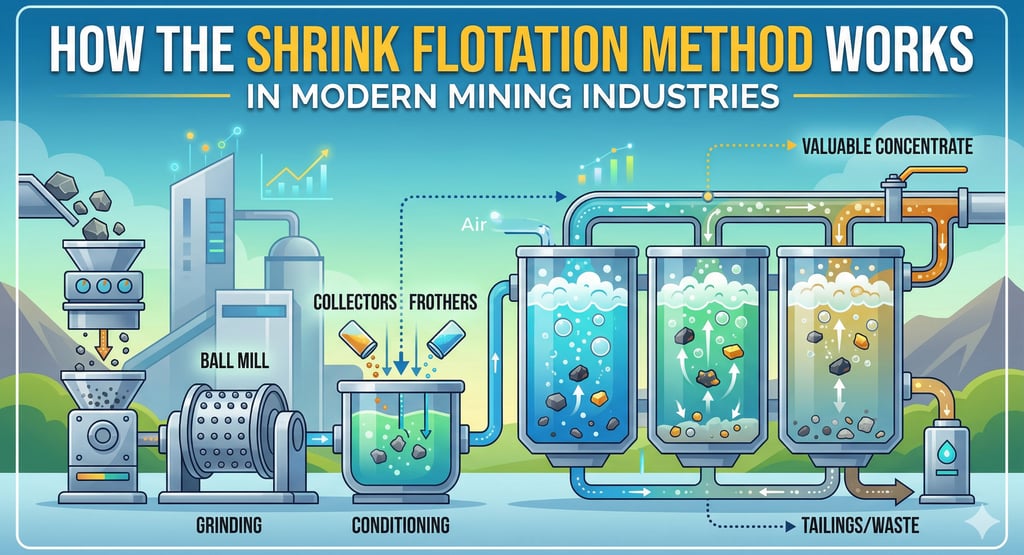
The ore is first broken up into small pieces and then ground into a fine powder before flotation. This makes the surface area bigger, which makes it easier to get rid of minerals that aren't useful.
The process of making foam
Flotation is an important part of the Shrink Flotation Method that comes after the ore has been crushed. This is how it works:
A slurry is a mixture of water and powdered ore.
People added chemicals known as frothers and collectors.
When you add air to the mix, it makes bubbles.
Bubbles rise to the top and pick up minerals that are good for you.
They take the foam off and leave the trash.
This step works well to get metals like lead, copper, gold, and zinc out of rocks.
There are a lot of good things about the Shrink Flotation Method.
A very good chance of getting back
This method uses controlled extraction and advanced flotation to find the minerals that are worth the most. This helps keep losses to a minimum.
Things that don't cost a lot of money to do
Flotation separates minerals quickly, which lowers the cost of processing. If you stop shrinkage, you won't need as many big support structures.
The environment is less harmed
Newer flotation methods use better chemicals that don't make as much waste and last longer than older methods.
Works well for ore bodies that are very steep.
This method works best on ore deposits that are steep and narrow and where other mining methods might not work.
Things That Can't Be Done and Problems
The Shrink Flotation Method has some good and bad points:
A lot of work: You need skilled workers and close supervision to make sure things don't get smaller.
Works best in rock formations that are stable and have steep ore bodies.
Ventilation issues: It can be hard for air to move around when you work underground.
It takes a long time: The slow extraction process can slow down production compared to bulk mining methods.
What They Do Now in the Mining Industry
As technology has improved, the Shrink Flotation Method has changed. Automation, real-time monitoring, and better chemical formulations have made it safer and more effective.
Today, mining companies make use of the following:
Digital sensors check the quality of the ore.
Automated drilling systems that do the job well.
Chemicals that don't hurt the environment and make flotation less effective.
These new ideas will keep the method useful and competitive in this new age of mining that is good for the environment.
Different minerals have different uses.
We use the Shrink Flotation Method to get and process a lot of minerals, such as the ones listed below:
Copper ore
There is gold in these ores.
Zinc and lead deposits
Sulfide minerals
People like it because it can change to fit ores that are hard to work with.
What comes next?
The Shrink Flotation Method will likely improve as the mining industry works to be more eco-friendly and efficient. The study is primarily focused on:
Using fewer chemicals in the flotation process
Making it easier for machines to dig deep into the ground
It takes less energy to grind and use it.
Even with these changes, this method will still be very important for getting the minerals the world needs while doing the least amount of harm to the environment.
In a word,
The Shrink Flotation Method is a great way to mix old and new ways of mining minerals. It uses both shrinkage stoping and flotation to make a method that works well for getting ore out of the ground and processing it.
It has some problems, but it's still a good way to mine today because it's cheap, works well, and can be changed. As technology gets better, this method will probably work better, last longer, and be used by more people.