
Performance Marketing Explained: A Beginner’s Roadmap
DIGITAL MARKETING
Pallabi Das
3/6/20265 min read
My post content Businesses are always looking for marketing strategies that work in the digital world, which is very competitive these days. In the past, marketers would use estimated reach and brand awareness to plan their campaigns. But now, businesses want to see proof that their marketing is actually making money. This is where performance marketing comes in.
Performance marketing is one of the most effective and results-driven digital marketing strategies because advertisers only pay when a certain action happens. Performance marketing makes sure that every dollar spent on marketing is linked to a measurable result, whether that's a click, a lead, a sale, or an app download.
This beginner's guide will explain what performance marketing is, how it works, and how businesses can use it to grow their businesses quickly.
What is marketing based on performance?
In performance marketing, advertisers only pay marketing platforms or partners when a certain action is taken.
These actions could be:
Clicks on a website
Leads or submissions of forms
Buying products
Downloads of apps
Sign up for the newsletter
Performance marketing is different from traditional marketing campaigns that charge based on impressions or ad placements. Instead, it focuses on results.
This model is very appealing to businesses because it lowers risk and raises return on investment (ROI).
How to Use Performance Marketing
Advertisers, marketing platforms, and affiliates or publishers all work together to make performance marketing work.
Here's a simple way to explain the process:
The advertiser makes a campaign A company starts a campaign to promote a good or service.
Ads Are Sent Out Ads are shown on a number of digital channels, including:
Engines of search
Sites for social media
apps for phones and websites
The audience interacts with the ads People who might buy something click on the ad or interact with the content.
The action is done. The advertiser pays for the result if the user does what they want (buy something, sign up, or download something).
This makes sure that every campaign has clear tracking and measurable results.
Important Channels for Performance Marketing
Performance marketing gets results by using a number of digital channels. Each channel has its own job to do when it comes to getting people to visit and make purchases.
1. Marketing on search engines (SEM)
Search engine marketing means putting ads on search engines like Google that people pay for.
People see these ads when they look for certain keywords.
For example, someone looking for "best digital marketing course" might see a paid ad at the top of the search results.
Pros:
Audience with a lot of intent
Right away, you can see
Fast lead generation
2. Ads on Social Media
Advertisers can run very targeted ads on sites like Facebook, Instagram, LinkedIn, and YouTube.
Advertisers can target certain groups of people based on:
Age
Interests
Behavior
Place of work
Profession
This makes advertising on social media very good at reaching certain groups of people.
3. Marketing through affiliates
Affiliate marketing is a way for publishers to work together to promote products and get paid for each sale they make.
For example, a blogger might use a special affiliate link to promote an online course.
The blogger gets a cut of the sale if someone buys something through that link.
Businesses like this model because they only have to pay when a sale is made.
4. Advertising that is native
Paid native ads fit in with the content of a website or platform in a way that makes sense.
Some examples are:
Paid articles
Sections of content that are recommended
advertised blog posts
Native ads usually get more people to interact with them because they don't feel as intrusive.
5. Performance-Based Influencer Marketing
Many brands now work with influencers on a pay-per-performance basis.
Brands might not pay influencers up front, but they might pay them based on:
Sales made
Leads that were caught
driven by traffic
This method makes sure that brands get measurable results from their campaigns with influencers.
Key Performance Indicators in Marketing Performance
One of the best things about performance marketing is that you can see how well your campaigns are doing right away.
Some important numbers are:
Cost per Click (CPC)
This shows how much an advertiser pays for each click on an ad.
CPC = Total Ad Spend ÷ Total Clicks
Cost Per Acquisition (CPA)
CPA tells you how much it costs to get a customer.
The formula is: CPA = Total Cost of Campaign ÷ Total Conversions
Rate of Clicks (CTR)
The click-through rate (CTR) tells you how many people click on an ad after seeing it.
To find CTR, use the formula: CTR = (Clicks ÷ Impressions) × 100
A higher CTR usually means that the ad is interesting and relevant.
Return on Ad Spend (ROAS)
ROAS tells you how much money you make for every dollar you spend on ads.
ROAS = Revenue Generated ÷ Ad Spend is the formula.
A campaign is profitable if it has a higher ROAS.
Advantages of Performance Marketing
Many businesses now prefer performance marketing because it has so many benefits.
Results that can be measured You can keep track of every campaign with detailed analytics. Businesses can see exactly how well their marketing budget is working.
Cost-Effectiveness Advertisers only pay when the action they want happens. This cuts down on money spent on ads that don't work.
Decisions Based on Data Performance marketing gives marketers useful information about how customers act, which helps them make their campaigns better all the time.
Scalability Businesses can easily raise their budget to help growth once a campaign starts to work.
Optimization in Real Time Marketers can change targeting, creatives, and budgets on the fly to make campaigns work better.
Problems with Performance Marketing
Performance marketing has a lot of benefits, but it also has some problems.
A lot of competition There is a lot of competition on popular advertising sites like Google and Facebook, which can drive up ad costs.
Tired of Ads People may stop paying attention to ads if they see the same creative over and over again. Ad creatives need to be updated on a regular basis.
Limits on tracking Changes to privacy policies and cookie rules can make it harder to keep track of conversions.
Risks of Fraud Some publishers may make up fake clicks or leads in affiliate marketing. Companies need to keep a close eye on their campaigns.
A Beginner's Guide to Starting Performance Marketing
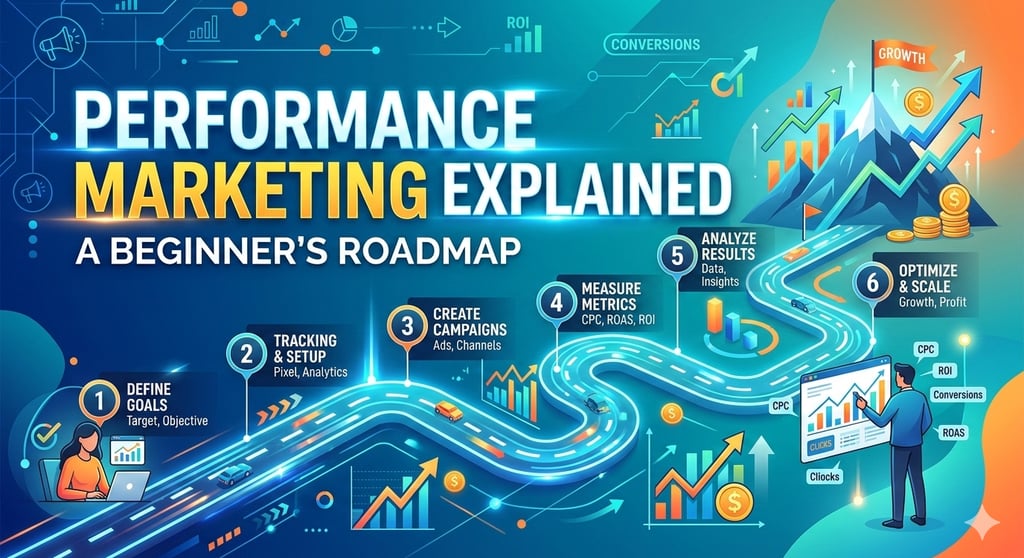
If you're new to performance marketing, these steps will help you make a good plan.
Step 1: Set a goal
To begin, figure out what your campaign's main goal is.
For example:
Get leads
Boost sales of products
Get people to visit your website
Get more people to sign up for your email list
Having clear goals helps you choose the right strategy.
Step 2: Pick the Right Platform
Choose marketing platforms based on who you want to reach.
For example:
Google Ads for traffic from search intent
Facebook and Instagram for getting people involved
LinkedIn for business-to-business marketing
Step 3: Make Landing Pages That Get a Lot of Sales
Your ad campaign should send people to a landing page that is well-optimized and encourages them to take action.
Important parts are:
clear title
strong call to action
copy that makes you want to buy
quick loading time
Step 4: Make a budget and a plan for how to bid
Set a budget and try out different bidding models, like:
CPC (Cost Per Click)
CPA stands for "Cost Per Acquisition."
CPM (Cost Per Thousand Impressions)
Testing helps find the best way to do things at the lowest cost.
Step 5: Keep an eye on and improve campaigns
For performance marketing to work, it needs to be watched all the time.
Marketers should look at:
how well ads work
getting people interested
rates of conversion
Using the data, campaigns can be improved to get better results.
What Will Happen to Performance Marketing in the Future
As technology gets better, performance marketing keeps changing.
Some big trends that will affect its future are:
AI-powered ad optimization
Using automation to manage campaigns
Better targeting of audiences through data analysis
Marketing strategies that put privacy first
As digital marketing relies more on data, performance marketing will still be one of the best ways for businesses to see real growth.
Conclusion
Performance marketing has changed how companies do digital advertising. Companies can now spend money on campaigns that get results and can be measured, instead of on marketing efforts that aren't sure to work.
To build successful campaigns, beginners need to know the basics of performance marketing, like the main channels, metrics, and strategies. Businesses can get the most out of their investments, get high-quality leads, and grow their businesses quickly and easily if they do things the right way.
As competition in the digital world grows, performance marketing will continue to be an important tool for brands that want to stay ahead in the fast-paced online market.